





 분야
분야 ppt
pptA Blessing or a Curse?
Abstract
THE THEORETICAL FRAMEWORK
STUDY 1、2、3、4
GENERAL DISCUSSION
4
1
2
3
Contents
Abstract
Results from four studies uncover a relatively automatic cultural congruency mechanism that can influence evaluations of culturally charged brand extensions, overriding the impact of perceived fit on extension evaluations.
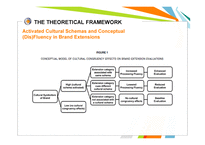
Culturally congruent extensions (i.e., when both the brand and the extension category cue the same cultural schema) were evaluated more favorably than culturally neutral extensions, which in turn were evaluated more favorably than culturally incongruent ones (i.e., cue two different cultural schemas).
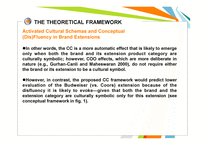
The effects emerged with both moderate and low fit brand extensions, as well as for narrow and broad brands. However, they only emerged when both the brand and the product were culturally symbolic, likely to automatically activate a cultural schema but did not emerge for brands low in cultural symbolism.
Abstract
The effects were driven by the processing (dis)fluency generated by the simultaneous activation of the same (different) cultural schemas by the product and the brand.
Many well-known brands become symbols or icons of the cultures or countries with which they are associated.
Examples of these brands include Budweiser (American), Sony (Japanese), Corona (Mexican), Burberry (British), or Armani (Italian).
Branding professionals invest resources in building cultural icons with the expectation of being rewarded with stronger market-leadership positions and higher levels of brand equity (Holt 2003; Leibig 2005;Shaw and Sudhaman 2005).
Abstract
Interestingly, the majority of the prior branding literature has focused primarily on the role of perceived fit in determining brand extension evaluation and success (Broniarczyk and Alba 1994; Keller 2002; Loken and John 1993; Park, Milberg, and Lawson 1991).
Importantly, even contextual factors (e.g., consumer’s mood; Barone, Miniard, and Romeo 2000), brand-specific variables (e.g., breadth of the brand; Meyvis and Janiszewski 2004), and consumer characteristics (e.g., self-construal; Ahluwalia 2008), have been known to impact extension evaluation through their influence on perceptions of fit.As such, our knowledge of other drivers of brand extension evaluations, such as a brand’s cultural symbolism, is relatively limited.
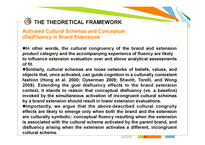
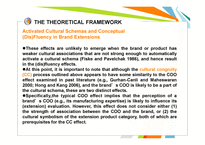
In contrast to the deliberate reasoning involved in the perceived fit or country-of-origin (COO) assessments that might be relevant for culturally iconic brands, the theoretical framework proposed in this article focuses on a less-conscious type of process based on cultural congruity (described in the next section) that operates independently of perceived fit, as well as COO inferences, and can presumably override the influence of these factors.
Abstract
They delineate conditions under which moderate-fit extensions for culturally symbolic brands might backfire and those under which low-fit extensions may have an increased chance of success.
As such, the theoretical framework attempts to enrich our understanding of the extendibility of well-known culturally symbolic brands by expanding the extant conceptualization beyond the role of perceived fit and COO inferences.
From a theoretical perspective, our findings open up lines of research focusing on subtler connections between brands and extensions (such as cultural congruity) and more effortless mechanisms that can significantly dampen the impact of perceived fit in driving extension evaluations.
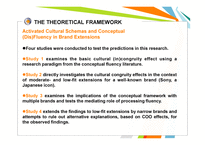
THE THEORETICAL FRAMEWORK
Cultural Schemas
According to the dynamic constructivist theory of culture (Chiu and Hong 2007; Hong et al. 2000), people with some direct or indirect experiences with a certain culture will develop a cognitive representation of it.
A cultural schema is a loose network of shared knowledge about a human group, consisting of a central concept (e.g., American culture) and its associated beliefs, values, and objects (including brands and products) that can operate below consciousness and that guide cognition only when it is accessible (Chiu and Hong 2006; Hong et al. 2000; Oyserman 2009).