

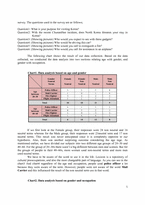



 분야
분야 docx
docx1. Videotaped interviews
2. Questionnaire
1. Introduction
2. Background Study
2.1 Research Hypotheses
3. Method
3.1. Linguistic and Social Variables
3.2 Subjects
3.3Data Collection and Data Analysis
4. Result
5. Conclusion and Implications
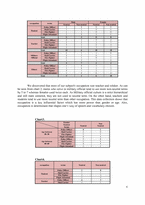
Chart3.
Gender
Neutral
Terms
Neutral Non
Neutral
Age between
20~30 Police Officer 8 2
Mail Carrier 2 8
Fire Fighter 5 5
Flight Attendant 6 4
Age between
40~60 Police Officer 7 3
Mail Carrier 2 8
Fire Fighter 4 6
Flight Attendant 5 5
Chart4.
occupation terms Neutral Non neutral
Student Police Officer 2 0
Mail Carrier 1 1
Fire Fighter 1 1
Flight Attendant 2 0
Teacher Police Officer 6 3
Mail Carrier 4 5
Fire Fighter 5 4
Flight Attendant 5 4
Military Police Officer 3 1
Mail Carrier 0 4
Fire Fighter 2 2
Flight Attendant 2 2
others Police Officer 4 1
Mail Carrier 2 3
Fire Fighter 2 3
Flight Attendant 1 4
4. Result
Based on our study we assumed that male and older people would use more non-neutral term. We defined one generation is about 20 years and that could cause the difference in the usage of words. So, our hypothesis was
1) Males who are in the age range of 40~60 will use less politically correct expressions than males that are in the age range of 20~40
2) Males would use less politically correct expressions than females
However, both of our hypotheses were rejected. It was very surprising and we tried to find the reason in the aspect of age, gender, occupation and familiarity to the terms. First, we analyzed our data by age and gender.
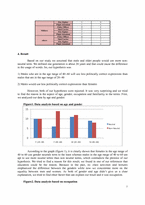
Figure1. Data analysis based on age and gender
According to the graph (figure 1), it is clearly shown that females in the age range of 40 to 60 use gender neutrals term to the least whereas males in the age range of 40 to 60 are apt to use more neutral terms than non neutral terms, which contradicts the premise of our hypothesis. We tried to find a reason for this result; we found in one of our references that education could be the reason. Because in the past, in- class activities and lectures emphasized the difference between the genders while now we concentrate more on the equality between men and women. As both of gender and age didn’t give us a clear explanation, we tried to find other factor that can explain our result and it was occupation.
Figure2. Data analysis based on occupation
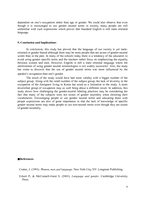
As shown in the graph, teachers are more likely to use neutral terms than non-neutral terms whereas military official are more likely to use non-neutral terms than neutral terms. Based on this result, we learned that gender is social construct and schools are key institutions for the construction of gender. As Gender equity is emphasized nowadays and schools have begun to enforce gender equity by trying to downplay gender difference in classroom. As teacher mostly
■References
Coates, J. (1993). Women, men and language. New York City, NY: Longman Publishing.
Eckert P., & McConnell-Gient S. (2003). Language and gender. Cambridge University Press
Holmes, J., & Meyerhoff, M. (2003). The handbook of language and gender. Malden, MA : Blackwell.
Wardhaugh, R. (2006). An introduction to sociolinguistics (5th ed.). Malden, MA: Blackwell Publishers.