



 분야
분야 docx
docxⅡ. Data description
2.1 Variable selection
2.2 Detailed description of the variables
Ⅲ. Data analysis
3.1 Graphs before fitting a model
3.1.1 One-dimensional graphs
3.1.2 Two-dimensional graphs
3.2 The initial model fit to the data
3.2.1 Estimation of the full model
3.2.2 Multicollinearity and variable selection
3.2.3 Backward elimination procedure
3.3 Diagnostics for our model
3.3.1 Residual analysis
3.3.2 The detection of outliers and influential observations
Ⅳ. Final model
Ⅴ. Conclusions
REFERENCE
As our world is called ‘Knowledge-information society’, human resource becomes a major driver of the national competitiveness. Intelligence is one of the most important factors in deciding excellent human resource. Therefore, a country should focus on improving people’s intellectual ability as one way of securing good resource to enhance its competitiveness. We thought that IQ (Intelligence Quotient) score can be a proper tool to estimate a country’s intellectual competitiveness, and we also focused on the differences of IQ scores between countries. These differences may come from the disparate environment by country such as wealth, education and welfare, by those things we can find some determinative elements related to IQ scores by comparing the difference between countries. With the result of this comparison, we can suggest the way to enhance the national competitiveness more than just improving personal intelligence, IQ. That is why we determined average IQ scores by country as the main subject of our project.
Ⅱ. Data description
2.1 Variable selection
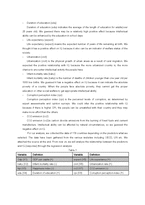
Our group started to think about the various factors that can be representative of the socio-economic elements considering the interrelationship with IQ scores. Finally, we selected 8 variables to explain the differences of IQ scores among the countries: GDP per capita, happiness index, duration of education, life expectancy, urbanization, corruption perception index, CO2 emission. We excluded the innate and natural factors here because those factors are not easy to identify the difference between indicators, additionally when there is homogeneity between countries, those factors cannot be the critical variables to evaluate our model for IQ. The following is the definition of our predictors and the expectation of relationship between the predictors and IQ.
http://www.indexmundi.com/g/r.aspx?v=67
http://stats.oecd.org/Index.aspx?DatasetCode=SNA_TABLE1
http://www.imf.org/external/index.htm
2.baby: infant morality rate (per 1000) http://en.wikipedia.org/wiki/List_of_countries_by_infant_mortality_rate
3.hpi: happiness index
http://www.happyplanetindex.org/
4.edu: Duration of education
http://hdrstats.undp.org/en/indicators/103006.html
5.expect: Life expectancy
https://www.cia.gov/library/publications/the-world-factbook/rankorder/2102rank.html
6.civil: urbanization rate
http://www.nationmaster.com/graph/peo_urb-people-urbanization
7.co2: co2 emission (ton / capita)
http://hdrstats.undp.org/en/indicators/default.html
8.cpi corruption perception index
http://cpi.transparency.org/cpi2011/results/
http://blog.naver.com/ktkimblog?Redirect=Log&logNo=165775096
9. IQ by country