





 분야
분야 pptx
pptxNORTH
Contents
Historical
Background
Administrative
System
of North Korea
Comparison
with
South Korea
Conclusion
Background
1
Historical
Historical Background
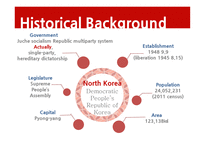
North Korea
Democratic
People’s
Republic of
Korea
Establishment
1948 9.9
(liberation 1945 8.15)
Area
123,138㎢
Legislature
Supreme
People’s
Assembly
Capital
Pyong-yang
Government
Juche socialism Republic multiparty system
Actually,
single-party,
hereditary dictatorship
Population
24,052,231
(2011 census)
Historical Background
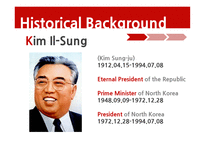
Kim Il-Sung
(Kim Sung-ju)
1912.04.15-1994.07.08
Eternal President of the Republic
Prime Minister of North Korea
1948.09.09-1972.12.28
President of North Korea
1972.12.28-1994.07.08
Historical Background
Kim Il-Sung
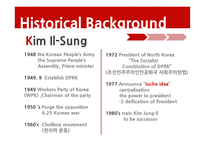
1948 the Korean People’s Army
the Supreme People’s
Assembly, Prime minister
1949. 9 Establish DPRK
1949 Workers Party of Korea (WPK) ,Chairman of the party
1950 ’s Purge the opposition
6.25 Korean war
1960’s Chollima movement
(천리마 운동)
1972 President of North Korea
“The Socialist
Constitution of DPRK”
(조선민주주의인민공화국 사회주의헌법)
1977 Announce “Juche idea”
centralization
the power to president
-> deification of President
1980’s train Kim Jung-il
to be successor
Historical Background
Kim Jung-Il
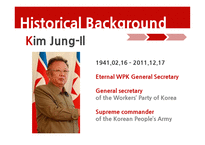
1941.02.16 - 2011.12.17
Eternal WPK General Secretary
General secretary
of the Workers’ Party of Korea
Supreme commander
of the Korean People’s Army
Historical Background
Kim Jung-Il
1961 enter Workers’ Party of
Korea
1963 Graduate Kim Il-sung
University, Political economy
Political activity
as a member of WPK
1992 the head of the state
constitutional reform
: consolidate the power of
supreme commander
of the Korean People’s Army
1993 Supreme commander of
the Korean People’s Army
1994 after Kim Il-sung died, 유훈통치
repeal President System
Bicameral government system
-> to dominate the national
defense and military power
1997 General secretary of
the Workers’ Party of Korea