

 분야
분야 ppt
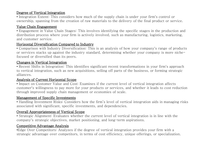
pptIntegration Extent: This considers how much of the supply chain is under your firms control or ownership, spanning from the creation of raw materials to the delivery of the final product or service.
Value Chain Engagement
Engagement in Value Chain Stages: This involves identifying the specific stages in the production and distribution process where your firm is actively involved, such as manufacturing, logistics, marketing, and customer service.
Horizontal Diversification Compared to Industry
Comparison with Industry Diversification: This is an analysis of how your companys range of products or services stacks up against the industry standard, determining whether your company is more niche-focused or diversified than its peers.
Changes in Vertical Integration
Recent Shifts in Integration: This identifies significant recent transformations in your firms approach to vertical integration, such as new acquisitions, selling off parts of the business, or forming strategic alliances.
Analysis of Current Horizontal Scope
Impact on Customer Value and Cost: Examines if the current level of vertical integration affects customers willingness to pay more for your products or services, and whether it leads to cost reduction through improved supply chain management or economies of scale.
Management of Specific Investments
Handling Investment Risks: Considers how the firm’s level of vertical integration aids in managing risks associated with significant, specific investments, and dependencies.
Overall Appropriateness of Vertical Scope
Strategic Alignment: Evaluates whether the current level of vertical integration is in line with the companys strategic objectives, market positioning, and long-term aspirations.
Competitive Advantage Analysis
Edge Over Competitors: Analyzes if the degree of vertical integration provides your firm with a strategic advantage over competitors, in terms of cost efficiency, unique offerings, or specialization.
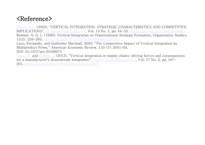
Mpoyi, R.T.(2003), "VERTICAL INTEGRATION: STRATEGIC CHARACTERISTICS AND COMPETITIVE IMPLICATIONS",Competitiveness Review, Vol. 13 No. 1, pp. 44-55. https://doi.org/10.1108/eb046451
Romme, A. G. L. (1990). Vertical Integration as Organizational Strategy Formation. Organization Studies, 11(2), 239-260. https://doi.org/10.1177/017084069001100204
Luco, Fernando, and Guillermo Marshall.2020."The Competitive Impact of Vertical Integration by Multiproduct Firms."American Economic Review,110 (7): 2041-64.
DOI: 10.1257/aer.20180071
Guan, W.andRehme, J.(2012), "Vertical integration in supply chains: driving forces and consequences for a manufacturers downstream integration",Supply Chain Management, Vol. 17 No. 2, pp. 187-201.https://doi.org/10.1108/13598541211212915