



 분야
분야 pdf
pdf2 Second order linear recurrence equations
2.1 General solution - introduction
2.2 Generating Functions
2.2.1 Homogeneous equation
2.2.2 Non-homogeneous solutions
2.3 Homogeneous and particular solution - hands on solution scheme
2.3.3 Solution to the full problem
3 Conclusion
We show that the homogeneous solution is a linear combination of exponential functions and the particular solution is of the same form as the RHS of the equation with an increase in polynomial order if any part of the RHS can be expressed in terms of the homogeneous solution, so called resonance.
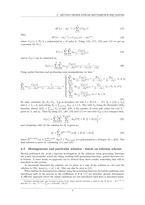
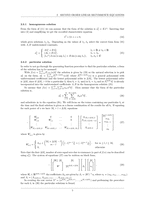
Using generating functions to solve such problems require a lot of computations and par- tial fractions expansions. Therefore a more hands on approach is presented and discussed where the forms of the homogeneous and particular solutions are assumed, based on the pre- viously derived solutions. The homogeneous solution is determined by solving a characteristic equation, and using the characteristic roots together with the assumed form of the solution the solution is given with two undetermined coefficients. The particular solution is found by substituting the assumed form of the particular solution into the equations and solving a linear system of equations. Finally the unknown coefficients are determined from the initial conditions.
[2] Parag H. Dave; Himanshu B. Dave, Design and Analysis of Algorithms, p.709, Pearson Education India, 2007, ISBN 978-81-775-8595-7
[3] Kauers, M., Paule P., The Concrete Tetrahedron, Symbolic Sums, Recurrence Equations, Generating Functions, Asymptotic Estimates, p.66 Texts and Monographs in Symbolic Computation, 2011, ISBN: 978-3-7091-0445-3
[4] Epp, Susanna, Discrete Mathematics with Applications, 4th ed., p317-319, DePaul University, BROOKS/COLE CENGANGE Learning, 2011
[5] Cull P.; Flahive M.E, Robson, R.O., Difference equations: from rabbits to chaos, p.74, New York : Springer, c2005, ISBN:0387232338
REFERENCES
∑N i=0
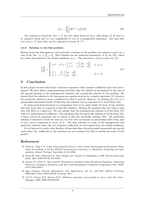
The solution is found for f(n) ∈ F but For other forms of f(n), other forms of apn have to be assumed which may be very complicated if f(n) is a complicated expression. Just note that cos n, sin n ∈ F since they can be expressed in terms of e±in.
2.3.3 Solution to the full problem
Having found the homogeneous and particular solutions to the problem the solution is given as a sum of the two , an = ahn + apn. This solution has two unknown parameters A, B, see (25), which are easily determined by the initial conditions a0,a1. The parameters A,B are given by (31).