






 분야
분야 hwp
hwp- Introduction of industry, and companies
we chose
2. Main Subject
- Each companies' Ratio analysis
- Selecting the main ratio by weight
3. Conclusion
- Selecting a best and worst company
2.1.4 Inventory Turnover ratio
Inventory Turnover ratio= Cost of goods sold / Average Inventory
Inventory Turnover ratio showing how many times a company's inventory is sold and replaced over a period. A low turnover implies poor sales and, therefore, excess inventory. A high ratio implies either strong sales or ineffective buying.
Commonly if this ratio high, company can decrease storage and insurance fee. Also the company can prevent inventory loss, and company's account payable is decreased.
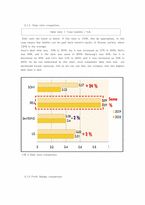
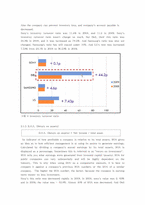
Sony's inventroy turnover ratio was 11.4% in 2008, and 11.5 in 2009. Sony's inventroy turnover ratio wasn't change so much. But Dell, their this ratio was 34.3% in 2008, and it was increased as 78.5%. And Samsung's ratio was also not changed, Samsung's ratio has still stayed under 10%. And LG's rate was increased 7.53% from 23.1% in 2008 to 30.53% in 2009.
그림 inventory turnover ratio
2.1.5 R.O.A. (Return on assets)
R.O.A. (Return on assets) = Net income / total asset
An indicator of how profitable a company is relative to its total assets. ROA gives an idea as to how efficient management is at using its assets to generate earnings. Calculated by dividing a company's annual earnings by its total assets, ROA is displayed as a percentage. Sometimes this is referred to as "return on investment".
ROA tells you what earnings were generated from invested capital (assets). ROA for public companies can vary substantially and will be highly dependent on the industry. This is why when using ROA as a comparative measure, it is best to compare it against a company's previous ROA numbers or the ROA of a similar company. The higher the ROA number, the better, because the company is earning more money on less investment.
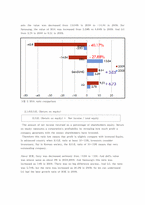
Sony's this ratio was decreased rapidly in 2009. In 2008, sony's value was 2. 63% and in 2009, the value was - 42.8%. Almost 40% of ROA was decreased. And Dell aslo the value was decreased from 13.04% in 2008 to -14.84 in 2009. But